From Horses to Gas to Hybrid to Electric: The Journey Continues
on
EV Education
EV Marketing
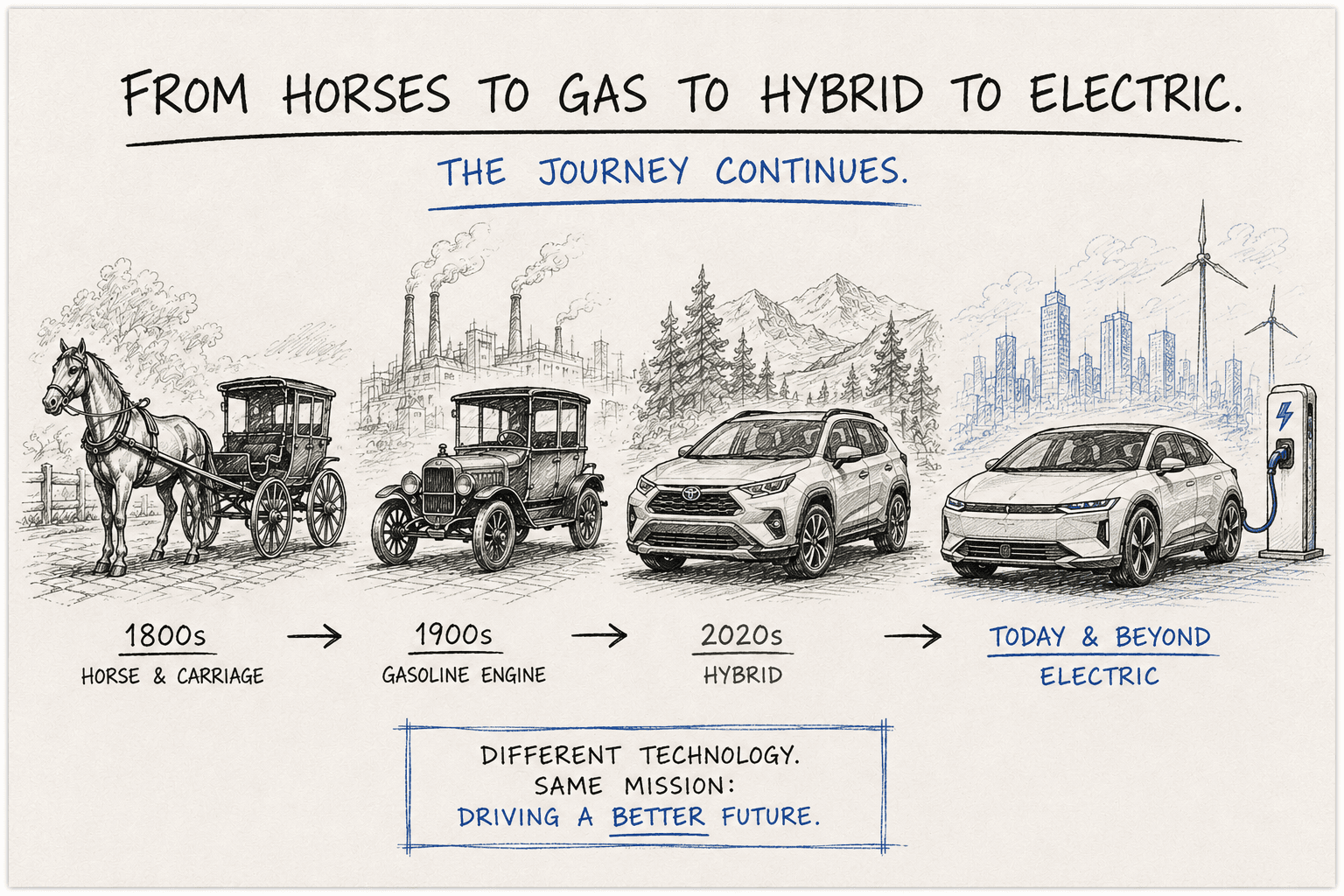
The companies that make electrification easier to understand will ultimately make it easier to adopt. And that may prove to be one of the most important competitive advantages of the next decade.
"Do you know when horses were banned?"
That was the question Martin Sander, Volkswagen's Board Member for Sales, Marketing and Aftersales, recently posed while discussing the future of electric vehicles.
The answer is obvious: they weren't.
People stopped buying horses because automobiles became better, cheaper, and more useful. The transition happened gradually, then suddenly.
The EV market feels remarkably similar today.
There's another reason Sander's analogy resonates. The transition is no longer theoretical. It's already happening across much of the world. In China, EVs and plug-in hybrids now account for more than half of new vehicle sales. Across Europe, electrified vehicles have become a mainstream part of the market. The United States is moving more slowly—not because consumers are rejecting electrification, but because America's vehicle fleet, infrastructure, geography, and buying habits are different.
The destination is increasingly clear. The path looks different depending on where you live.
For the past few years, headlines have focused on whether EV adoption is accelerating or slowing down. That's the wrong question. The more interesting question is how consumers are moving toward electrification—and increasingly, the answer isn't through battery-electric vehicles alone. It's through hybrids.
If you spend time with dealerships, this shouldn't come as a surprise. Dealers aren't reading forecasts; they're talking to customers. And customers have been sending a fairly consistent message: they like electrification, but many aren't ready to go fully electric.
The numbers support it.
Hyundai and Kia, two companies that have invested heavily in EVs, are also seeing tremendous success with hybrids. Hyundai's hybrid sales recently jumped more than 40% year-over-year, while Kia's increased more than 50%. Toyota, long criticized for its cautious approach to EVs, suddenly looks far less out of step than many industry observers once believed. The market is finding its own pace.
Rivian CEO RJ Scaringe recently made another observation that deserves attention. He argued that America doesn't have an EV demand problem as much as it has a product problem. His evidence? The Tesla Model Y and Tesla Model 3 still account for roughly half of all EV sales in the United States. Half!
That statistic alone explains much of the industry's current position. If two products account for 50% of a market, the story isn't that consumers aren't interested. The story is that consumers are still waiting for more compelling choices. More affordable EVs, more body styles, more mainstream vehicles designed for the majority.
This distinction matters. Too often, conversations about EV adoption focus exclusively on the United States. Globally, the industry has already crossed an important threshold: electrification is no longer an emerging trend. It's a core part of product planning for every major automaker. The debate has shifted from if consumers will electrify to how and how quickly.
In that context, hybrids aren't competing with EVs. They're buying time for the market to mature. BMW appears to recognize this reality. Jochen Goller, a member of BMW's Board of Management, recently described electrification as a "rollercoaster ride," arguing that it would be naive to think the transition would move in a straight line. BMW continues investing in EVs, but it is also investing in hybrids and combustion vehicles because customer demand rarely follows industry forecasts.
Hybrids aren't competing with EVs. They're buying time for the market to mature.
From where we sit at Lectrium, this is exactly what dealerships are navigating every day.
The average consumer isn't choosing between a gas vehicle and an EV anymore. They're choosing between a gas vehicle, a hybrid, a plug-in hybrid, and a battery-electric vehicle. Each comes with different economics, different ownership experiences, and different questions.
That's why education has become one of the most important parts of selling electrified vehicles. Whether a customer is comparing fuel savings on a hybrid, evaluating charging options for a BEV, calculating ownership costs, or simply trying to understand which technology fits their lifestyle, dealerships increasingly need better ways to communicate value.
The lesson from today's market is surprisingly simple: electrification is advancing, but consumers are choosing their own path.
Around the world, adoption is taking different forms. In some markets, EVs are leading the transition. In others, hybrids have become the bridge. What matters is not the pace of any single technology, but the broader shift toward electrified mobility.
For the industry, that makes consumer education just as important as product development. Buyers need help understanding the economics, ownership experience, and tradeoffs of an increasingly complex vehicle landscape.
The companies that make electrification easier to understand will ultimately make it easier to adopt. And that may prove to be one of the most important competitive advantages of the next decade.
Get in touch with Lectrium to educate your shoppers on EVs and Hybrids here: https://www.lectrium.com/book-a-demo
Previous post:


