Learn how dealership sales teams and marketing directors can build value in EVs and Hybrids by translating efficiency, charging costs, and fuel savings into simple customer-facing math.
The EV Sales Conversation Should Not Start With MPGe
Gas is expensive. Customers know it.
They feel it every time they fill up. They see it on road trips. They talk about it at the kitchen table. They may not walk into the dealership asking for an EV, but they are absolutely aware that gas prices are taking a bigger bite out of their wallet.
That creates an opening for dealers.
But too often, the EV conversation gets lost in language that customers do not feel.
MPGe.
kWh.
Battery capacity.
Charging curves.
Level 2.
DC fast charging.
Those things matter, but they are not always the best way to build value.
A customer does not emotionally connect with “35 kWh per 100 miles.”
They understand a $100 bill.
That is why one of the simplest EV sales strategies is also one of the most powerful:
Ask the customer how far they think $100 can take them.
Then show them the answer.
The $100 Bill Test
Here is the framing.
A customer is looking at an electric SUV. Maybe they are also considering a premium gas SUV. Instead of starting with technical specs, the salesperson pulls out a simple comparison.
Same wallet. Same $100 bill. Two different vehicles.
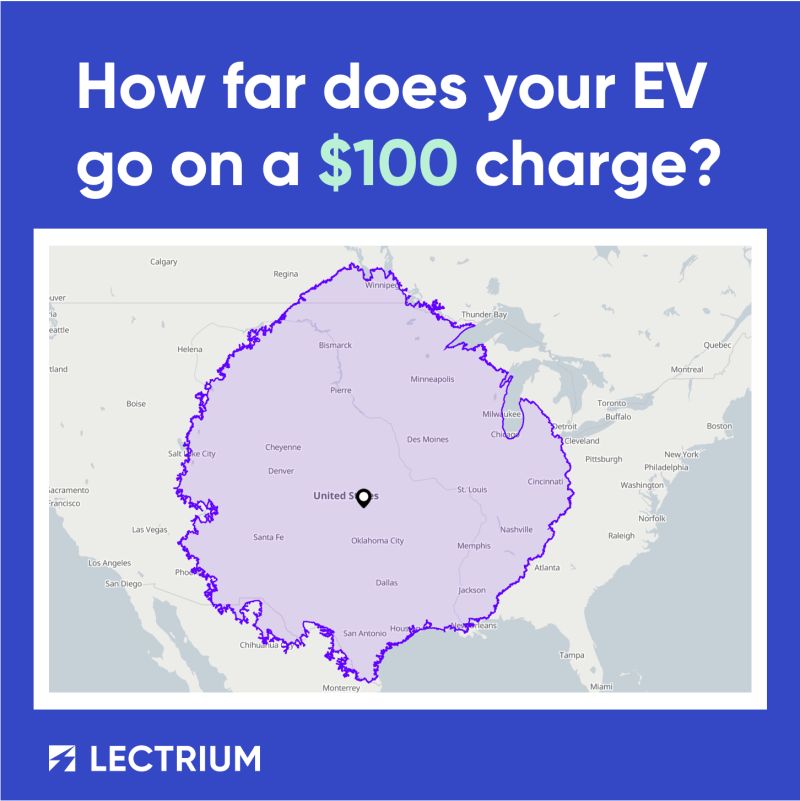
In Kansas, public charging averages around $0.294 per kWh, according to AAA data. Using that electricity cost, a Polestar 3 Single Motor can travel about 959 miles on $100 of electricity.
That is not just a full charge. That is more than three full charges.
To make it visual, that is roughly the distance from Winnipeg, Canada to Monterrey, Mexico on one $100 bill.
Now compare that to a 24 MPG premium gas SUV.
At $4.82 per gallon, $100 buys about 20.7 gallons of gas. At 24 miles per gallon, that gets the customer about 499 miles.
The EV goes about 92% farther on the same $100.
That is the moment the customer understands.
Not because they suddenly care about MPGe.
Because they care about money.
The Exact Math: How Far Does $100 Take You in an EV?
There are two simple ways to calculate how far a dollar amount can take a shopper in an EV.
Method 1: Using miles per kWh
Formula:
EV miles = ($ budget ÷ electricity price per kWh) × miles per kWh
Using the example:
$100 ÷ $0.294 per kWh = 340.14 kWh
If the EV gets approximately 2.82 miles per kWh:
340.14 kWh × 2.82 miles per kWh = 959 miles
So the EV can travel approximately:
959 miles on $100 of electricity
Method 2: Using kWh per 100 miles
Many EV specs are shown as kWh per 100 miles. In that case, use this formula:
EV miles = ($ budget ÷ electricity price per kWh) ÷ (kWh per 100 miles ÷ 100)
Using the example:
$100 ÷ $0.294 = 340.14 kWh
If the vehicle uses about 35.5 kWh per 100 miles:
340.14 ÷ (35.5 ÷ 100) = 958 miles
Rounded:
About 959 miles
Polestar lists the Polestar 3 Long range Single motor at an EPA-estimated 105 combined MPGe, and its U.S. configuration page shows energy use around 44.0 kWh/100 miles for certain configurations, with efficiency varying by trim and conditions. The exact number a dealer uses should always match the specific VIN, trim, wheel package, and local electricity rate being shown to the shopper.
The Exact Math: How Far Does $100 Take You in a Gas Car?
Gas math is even simpler.
Formula:
Gas miles = ($ budget ÷ gas price per gallon) × MPG
Using the example:
$100 ÷ $4.82 per gallon = 20.75 gallons
If the gas SUV gets 24 MPG:
20.75 gallons × 24 MPG = 498 miles
Rounded:
About 499 miles
Now compare the two.
EV: 959 miles
Gas SUV: 499 miles
Difference: 460 more miles
Percentage advantage: (959 - 499) ÷ 499 = 92.2%
The EV goes approximately:
92% farther on the same $100
That is the value story.
Dealers Should Sell Cost Per Mile, Not Just Range
Range matters.
But cost per mile is often the better sales conversation.
A gas SUV that gets 24 MPG at $4.82 per gallon costs:
$4.82 ÷ 24 = $0.201 per mile
That is about:
20 cents per mile
An EV that gets 2.82 miles per kWh at $0.294 per kWh costs:
$0.294 ÷ 2.82 = $0.104 per mile
That is about:
10 cents per mile
So in this example, the EV costs roughly half as much to drive per mile.
That is the kind of number a customer can feel.
A 40-mile daily commute becomes easier to understand:
Gas SUV: 40 miles × $0.201 = $8.04 per day
EV: 40 miles × $0.104 = $4.16 per day
Difference:
About $3.88 saved per day
Across 250 commuting days:
About $970 per year in commuting fuel savings alone
That does not include weekend driving, road trips, home charging savings, maintenance differences, incentives, or any other cost-of-ownership factor.
This is how a salesperson builds value.
Not by saying “EVs are efficient.”
By showing the customer what efficiency means in their wallet.
Why This Matters for Salespeople
Most customers do not need a lecture on battery chemistry.
They need confidence.
The salesperson’s job is to translate unfamiliar EV terms into familiar ownership value.
Instead of saying:
“This vehicle has strong MPGe.”
Say:
“Let’s look at what $100 actually buys you in this vehicle versus a comparable gas SUV.”
Instead of saying:
“This EV uses about 35 kWh per 100 miles.”
Say:
“At today’s charging rates, your cost per mile could be around half of what you would pay in a similar gas SUV.”
Instead of saying:
“This EV has competitive range.”
Say:
“For the same $100, this vehicle can go hundreds of miles farther than a comparable gas SUV.”
That is a better conversation.
It is practical. It is visual. It is financial. It is easy for the customer to repeat when they go home and talk to their spouse, partner, parent, or friend.
Great EV salespeople do not just explain the car.
They explain the ownership case.
Why This Matters for Marketing Directors
For marketing directors, the opportunity is even bigger.
Most dealership websites still merchandise EVs and Hybrids like gas cars.
A typical VDP might show:
Photos
Price
Payment estimate
Basic specs
Generic fuel economy
A lead form
That is not enough for an electrified shopper.
EV and Hybrid shoppers need more context before they convert. They want to understand range, charging, savings, incentives, battery health, and real-life ownership.
That means the dealership website has to do more of the educational work before the shopper ever talks to the sales team.
A strong EV merchandising strategy should answer questions like:
How much could this vehicle save me compared to gas?
How far can I drive on $100?
What does charging cost in my area?
Can I charge at home?
What does this vehicle’s range mean for my lifestyle?
How does this EV compare to a gas SUV?
What should I ask the salesperson?
If the website does not answer those questions, the shopper may leave before becoming a lead.
If the website does answer them, the dealership creates a more confident shopper and a warmer sales conversation.
That is electrified merchandising.
EV Value Needs to Be Merchandised Before the Customer Asks
The biggest mistake dealers make is waiting for the customer to ask about EV savings.
Most customers will not ask the perfect question.
They may not say:
“What is the cost per mile difference between this EV and a comparable 24 MPG gas SUV based on local energy rates?”
But they are thinking:
“Is this actually cheaper to own?”
“Will I save money?”
“Is this worth learning?”
“Am I going to regret buying something different?”
That is why dealers need to put the data directly in front of shoppers on the VDP.
Not buried in a spec sheet.
Not hidden in a PDF.
Not left for the salesperson to improvise.
Right on the vehicle page.
The VDP is where intent happens. It is where shoppers compare vehicles, evaluate price, imagine ownership, and decide whether to submit a lead.
If an EV or Hybrid VDP does not explain ownership value, the dealer is leaving the most important part of the story untold.
Gas Prices Do Not Create EV Buyers Alone
High gas prices do not automatically turn every shopper into an EV buyer.
But they do create curiosity.
They crack the door open.
A customer who was not considering an EV may start asking:
“Would this actually save me money?”
That is the dealer’s opportunity.
The dealers who win are not the ones who simply say, “Gas is expensive, buy an EV.”
The dealers who win are the ones who can show the math, personalize the ownership story, and make the customer feel confident.
That requires better merchandising, better sales enablement, and better customer-facing data.
The Dealer Playbook: How to Build Value in an Electrified Unit
Here is a simple framework salespeople and marketing teams can use.
1. Start With the Customer’s Wallet
Lead with a number the customer understands.
“What do you think $100 gets you in this EV compared to a gas SUV?”
That question is simple, visual, and memorable.
2. Translate Efficiency Into Miles
Do not stop at MPGe.
Show how many miles the customer can drive on a fixed dollar amount.
That turns abstract efficiency into real-world value.
3. Compare Against a Familiar Gas Vehicle
A customer needs a reference point.
Compare the EV against a gas SUV with a realistic MPG number. In this example, the comparison is a 24 MPG premium gas SUV.
4. Show Cost Per Mile
Cost per mile is one of the clearest ways to explain EV affordability.
It helps the customer understand daily driving, commuting, and long-term ownership.
5. Personalize the Math
The best version of this is not generic.
Use:
Local gas prices
Local electricity prices
The customer’s estimated annual mileage
The specific VIN or trim
Their commute or driving habits
Home charging assumptions, when available
The more personal the math, the more powerful the value story.
6. Put It on the VDP
Do not make the customer wait for the showroom conversation.
Show fuel savings, charging cost, range, and ownership value directly on the dealer website.
That helps shoppers build confidence earlier in the buying journey.
This Is the Future of EV Sales Strategy
Dealers do not need to turn every salesperson into an electrical engineer.
They need to turn EV data into customer value.
That is the real unlock.
The best EV sales strategy is not about overwhelming shoppers with technical details. It is about making the benefits simple, financial, and personal.
A customer may not remember the battery size.
They may not remember the MPGe.
They may not remember the charging curve.
But they will remember this:
“For the same $100, this EV can go about 92% farther than a comparable gas SUV.”
That is a sales story.
That is a marketing story.
That is a VDP story.
And for dealers serious about selling more EVs and Hybrids, it is a story that needs to be told before the customer ever asks.
How Lectrium Helps Dealers Build Value in EVs and Hybrids
At Lectrium, we help dealerships merchandise EVs and Hybrids with the information shoppers actually need to move forward.
That includes:
VIN-specific EV range information
Charging education
Localized fuel and electricity savings
Cost-of-ownership tools
EV Reports for sales and BDC follow-up
Electrified VDP experiences
GA4 event tracking for shopper engagement
EV and Hybrid analytics for dealership teams
The goal is simple:
Help dealers turn electrified inventory into understandable, measurable, and sellable inventory.
Because EVs should not be pitched like a tech demo.
They should be merchandised like a better ownership decision.
And sometimes, the best way to start that conversation is with a $100 bill.
Previous post:


