A Dealer Guide to Selling Used Teslas
Lucas McLaughlin
on
EV Education
Electrified Merchandising

Tesla changes hardware mid-production and ships fleetwide software. Here's why that breaks used-car tooling — and how dealers can build trust by answering honestly. Read time: ~7 min
Selling Used Teslas Isn't Like Selling Anything Else
Here's a situation that happens more often than you might think:
Two Model Ys sit on your pre-owned lot. Same model year. Same trim. Same color, similar mileage, prices within a few hundred dollars of each other.
At 10pm, a shopper has both vehicle pages open in side-by-side tabs, trying to work out which one has the newer self-driving computer. Your listings don't say. Your chat widget wants a phone number before it says anything.
The answer they are looking for isn't in the listing, isn't on the window sticker, and isn't in the VIN. And one of those two cars will receive future Tesla features the other one won't.
So they go looking elsewhere — a search engine, a forum thread, or whichever AI assistant they've come to trust. They'll find an answer. It just won't come from you, it may or may not be right about the specific car on your lot, and most of the time you'll never know the question came up.
The real answer is sitting on that car's touchscreen, a few taps into a settings menu. The shopper just never got as far as your lot to find it.
This isn't a data-quality problem a feed provider will eventually clean up. It's a permanent consequence of how Tesla builds cars and updates them.
There are nuances at play here that apply to used Teslas and to nothing else on your lot. Let's get into them.
Tesla doesn't have model years the way the rest of the industry does...sort of
Every other manufacturer typically freezes a specification for a model year. There's an order guide. Changes happen at the model-year break, they get announced, and they land in the books your appraisers use. A century of dealership process is built on that assumption.
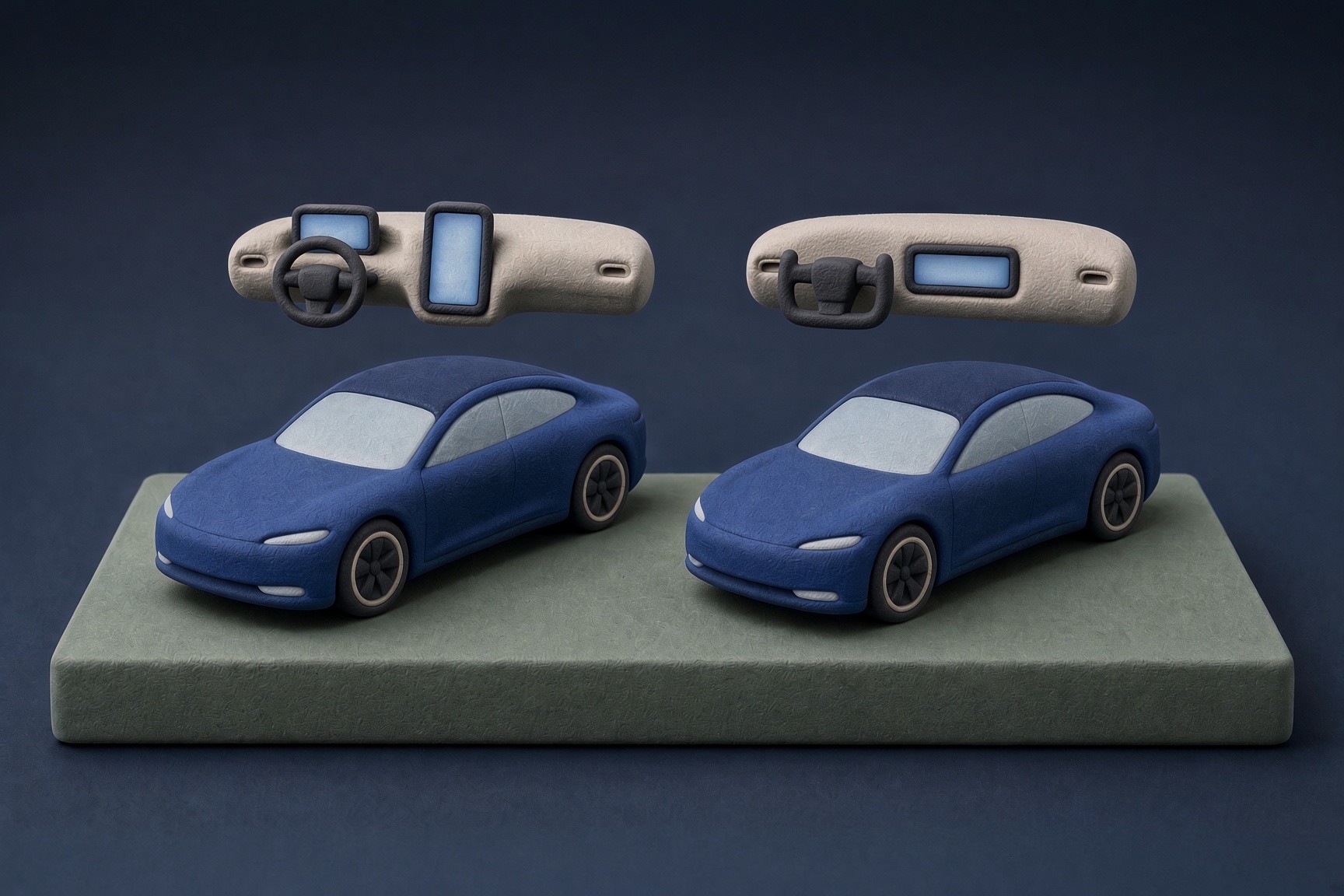
Tesla changes hardware continuously, and doesn't always announce it. Sometimes the change lines up with a model year: the Model 3 refresh arrived as a 2024, the redesigned Model Y as a 2026. Often it doesn't — the 2021 Model S refresh landed mid-year, so a "2021 Model S" is either the old car or the Palladium redesign depending on the month it was built.
And it's everything in between that really doesn't play by those rules: changes land mid-run, sometimes mid-quarter, and often at one assembly plant months before another. A few examples from the public record:
When the Model Y switched to Hardware 4 in North America in May 2023, it didn't happen all at once — Hardware 3 and Hardware 4 cars were being handed over side by side off the same delivery lot.
Ultrasonic parking sensors — the hardware behind original Autopark and Summon — came out of the lineup starting in late 2022 when "Tesla Vision" was introduced.
Battery chemistry has differed between cars wearing the same trim badge, depending on which factory built them.
The infotainment processor changed mid-run, which is why some used Teslas run apps and games that others simply can't — and why a few older ones still run games the newer cars lost.
Almost none of it arrived with a press release or an order guide. Which means "2023 Model Y" isn't a specification. It's a date range that happens to contain more than one car.
Over-the-air updates and Full Self-Driving
Most people assume over-the-air updates flatten the differences. The car keeps improving, so an older Tesla gradually catches up to a newer one. For much of the infotainment experience that's true, and it's one of the real pleasures of Tesla ownership — the car you bought three years ago picked up a new interface, new apps, new games, none of which you paid for.
It isn't true of everything. And it's least true of the feature used Tesla shoppers now ask about first: Full Self-Driving.
That's not a niche concern anymore. On its second-quarter 2026 earnings call, Tesla said roughly 55% of its North American deliveries that quarter had FSD enabled at the time of delivery, and reported 1.48 million active FSD subscriptions — up 56% year over year. Many of the people shopping your used Teslas have been paying attention to this.
To see why that matters, it helps to put the two software experiences side by side — especially since a good share of used Tesla shoppers are already Tesla owners, arriving with expectations set by the car in their driveway.
With a conventional vehicle, a software update is a service action. It's tied to a specific build, applied at a store, and the customer mostly never thinks about it.
Conversely, Tesla runs an over-the-air software ecosystem. Updates go to the whole fleet, on Tesla's schedule, with release notes every owner reads.
But what actually installs depends on the hardware underneath. Tesla's own support documentation states that features vary by "vehicle configuration, hardware, software version, region, model, vehicle trim and model year." The update is universal. The outcome is not.
So on infotainment, the fleet mostly converges. On the capability shoppers now care most about, it diverges — and it diverges further with every release, because each new version of FSD is written for the newest hardware.
That's why a used Tesla shopper asks about features the car doesn't have yet. When they ask "will this one get that," they're asking a hardware question in software language.
Tesla supplied the sharpest example itself. In April 2026, on its first-quarter earnings call, Tesla confirmed that vehicles with its Hardware 3 computer will not be capable of Unsupervised Full Self-Driving. Supervised FSD still works on those cars, and that distinction matters — it's exactly the nuance a shopper will want drawn precisely. But it's a permanent capability ceiling, announced years after those cars were sold, on vehicles sitting on pre-owned lots right now.
For a shopper buying partly on where the car is headed rather than only on where it is today, that one fact can decide between two otherwise identical cars.
Where this costs the store money
One thing to note first:
The used Tesla market is getting stronger, not weaker.
Used Tesla asking prices rose 4.3% between September 2025 and January 2026 — a window spanning the expiration of the federal EV tax credit on September 30 — while all other used EVs fell 3.6%.
Over the same period, 12,000 to 16,000 used Teslas per month sold through non-Tesla dealerships, and Tesla led the used EV market every month of 2026.
iSeeCars, analysis of 1.7M+ used vehicles · Cox Automotive EV Market Monitor, 2026
That's a lot of valuable inventory with an unanswered questions attached. Not knowing the answer costs you in four places.
Acquisition. If two same-year cars have different capability ceilings, they arguably carry different values — and that difference isn't in the book. Buying at auction without knowing means buying a coin flip on a specification some shoppers care about more than mileage.
Merchandising. The attribute your best-informed shoppers filter on isn't in your feed. Information about something like FSD capability is nowhere to be found on most dealer websites. Which raises the obvious question: where does the shopper go for the answer? Google, Tesla's own site, and now — ChatGPT, Claude, Grok or Gemini. Cox Automotive measured 19% of buyers using AI tools during their purchase in 2025. Among shoppers in the market today, 63% say they will definitely or probably use AI on their next purchase — against just 29% of dealers who have started adjusting to AI-powered search.
The sales floor. Tesla shoppers are unusually self-educated. Many have read more forum threads on this than anyone at the store has — the ex-Tesla employees on our team can attest to that. A salesperson who guesses and guesses wrong doesn't just lose that point; they lose the shopper's confidence in everything else they said, including the parts that were true. And in the worst case it costs real money: a shopper who understands what a Hardware 4 computer is worth better than your salesperson does will happily buy that car at a Hardware 3 price.
After the sale. "You told me it would get that" is the expensive conversation. It's a CSI problem, sometimes a buy-it-back problem, and depending on how the claim was made, an advertising-accuracy problem.
Why a non-answer is the worst outcome
Go back to that shopper with two tabs open. Nothing on the page answers the question, so they leave. That's the outcome to worry about most — not because they were told something wrong, but because you never entered the conversation at all. No lead, no record, no second chance.
What they find instead is an answer about Model Ys in general. The better models handle it carefully — they'll say it depends on the build date and that you should check the car itself. But a careful general answer still isn't an answer about the VIN on your lot. It can be perfectly reasonable and still be wrong about your specific car. And because the conversation happened somewhere else, nobody at your store ever gets the chance to correct it.
Dealership chat tools tend to land here too, with an extra step: they ask for a name, email and phone before they've said anything that earns them.
The capability that matters here isn't knowing more. It's knowing the boundary — telling the difference between a question you can answer from the listing and a question that needs the car in front of you.
How Lectrium closes the gap
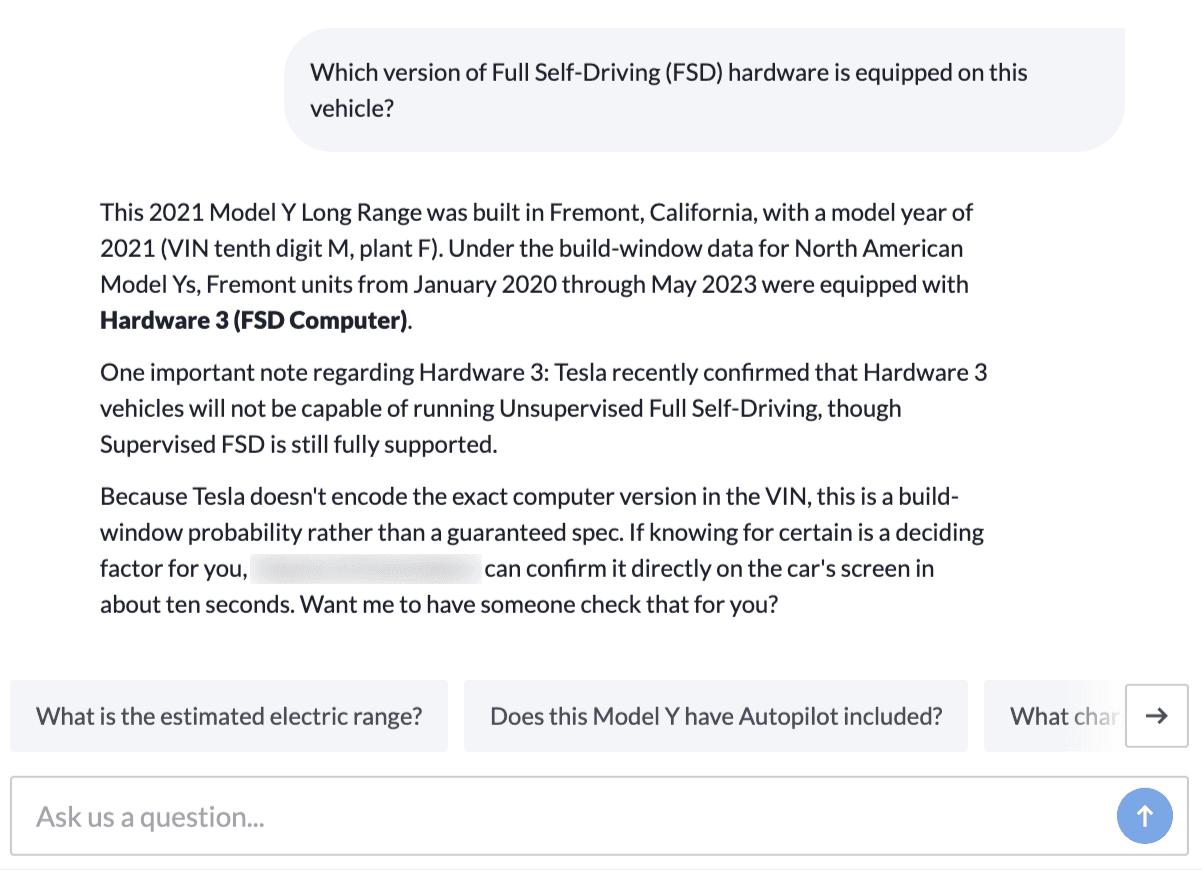
Earlier this year, Lectrium deployed an AI Agent merchandising interface on EV & hybrid VDPs.
The screenshot above is the agent answering a real hardware question on a real vehicle page. Four things are happening in that answer, and each one is deliberate.
It knows which car it's talking about. Not Teslas in general — that vehicle, that build, that VIN.
It works from a Tesla hardware reference matrix of public information layered into the Lectrium database, rather than from whatever the open internet last said.
It separates what it can state from what it can only narrow. Look at the third paragraph of that answer: because Tesla doesn't encode the computer version in the VIN, this is a build-window probability, not a guaranteed spec. That's an honest answer — and to a well-informed shopper, a far more credible one than false certainty.
Then it does the useful thing. It offers to have someone at the store confirm on the vehicle and follow up. The question becomes a conversation, and a better lead than a form fill, because the shopper has just told you the exact specification their decision turns on.
Those questions also land in Lectrium OS, so you can see which vehicles in your own inventory are generating hardware questions. That's a buying signal and an acquisition signal.
The honest answer is the competitive one
The instinct is to treat "I'm not certain" as a lost sale. In this category it's the opposite.
Tesla shoppers can tell the difference between a store that understands the nuance and a store that's bluffing, and they are grading you on it. Being the store that says here's what I can tell you from the listing, here's what I'd need to check on the car, and here's me checking it is a genuine differentiator — because almost nobody does it.
The cars will keep changing after you sell them. That isn't going away. The only part you control is whether your store is the one that can talk about it accurately.
See what your shoppers are actually asking about your used EV inventory. We'll walk you through our AI Agent integration on your own vehicle pages.
Major updates are around the corner for the Lectrium Agent — meet us at Digital Dealer 2026 for a live demo, or get in touch beforehand for a sneak peek.
Previous post:


